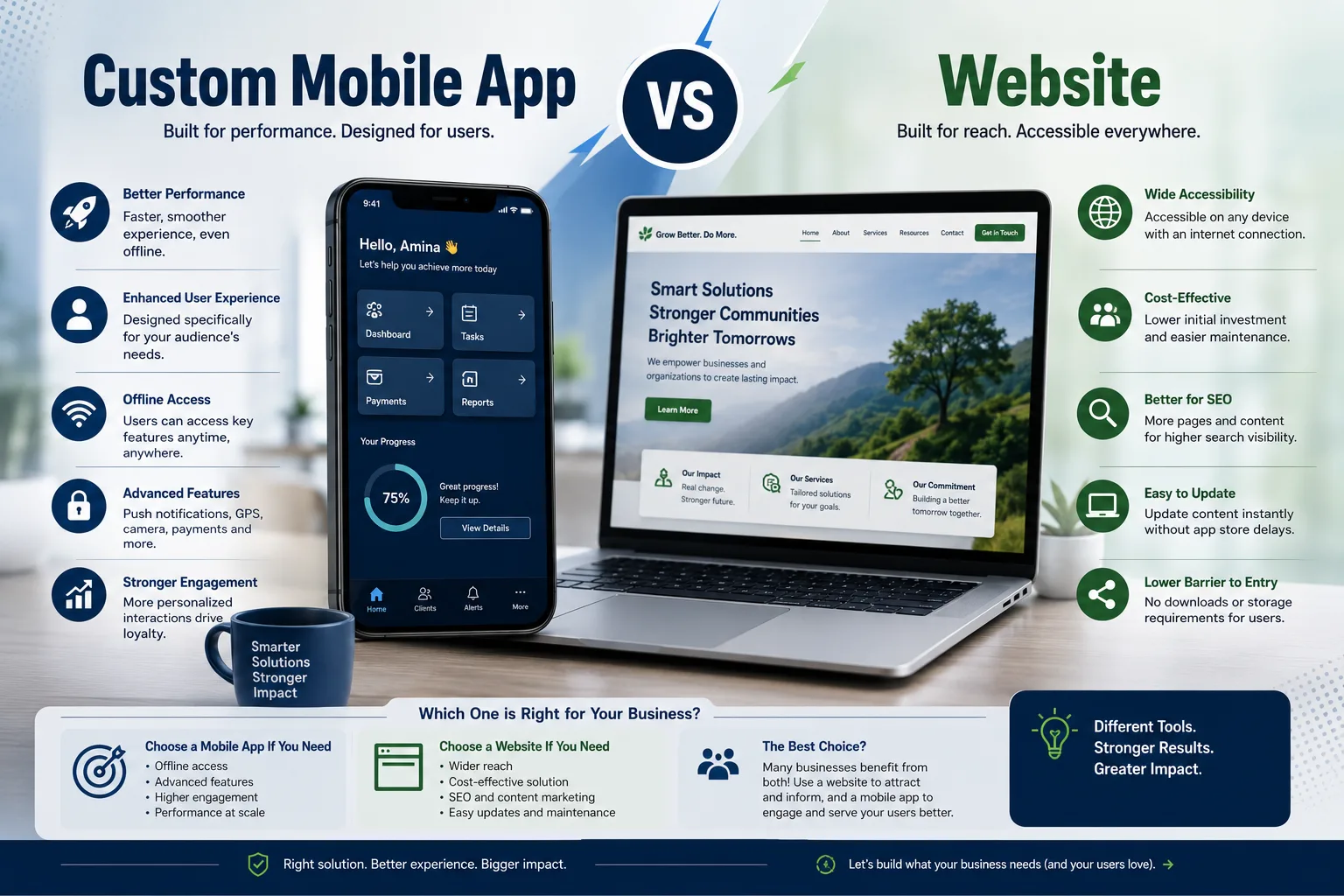
"Should we build an app?" is a question almost every growing business eventually asks — often driven by a competitor's app, a customer request, or a general sense that apps feel more "serious" than a website. But building a mobile app is a significant investment, and for many businesses, a well-built website (particularly a mobile-optimized one) actually serves customers just as well, at a fraction of the cost and complexity.
Here's a clear-eyed comparison to help you figure out which one your business genuinely needs.
What a Website Offers
A website is accessible instantly through any browser, on any device, without requiring installation. Modern, mobile-optimized websites can deliver much of what people associate with "app-like" experiences — fast loading, smooth interactions, and even some offline functionality through modern web technologies — without the friction of an app store download.
Strengths:
- No installation required — customers access it immediately via a link or search
- Works across all devices and operating systems from a single build
- Generally faster and less expensive to build and maintain than a native app
- Fully indexable by search engines, supporting organic discovery through SEO
- Easier and faster to update, since changes deploy instantly without app store review delays
What a Mobile App Offers
A native mobile app is downloaded and installed from an app store, running directly on the device's operating system, with deeper access to device features than a website typically has.
Strengths:
- Deeper integration with device features — push notifications, camera, GPS, offline functionality, biometric login
- Generally faster and smoother performance for complex, interaction-heavy functionality
- A persistent icon on the customer's home screen, offering ongoing visibility and easy re-engagement
- Push notifications provide a direct, high-visibility communication channel not available through a website
Costs and tradeoffs:
- Significantly higher development cost than a comparable website, particularly if building for both iOS and Android
- Requires customers to actively download and install it — a real barrier compared to a website's instant accessibility
- Ongoing costs for app store fees, updates, and compatibility maintenance across OS versions
- Slower update cycles, since app store review processes can delay how quickly changes reach users
When a Website Is the Right Choice
For most businesses, a website — particularly a well-built, mobile-first one — is the more practical starting point:
- Service businesses (consultants, auditors, law firms, agencies) rarely need app-specific functionality; a fast, informative, mobile-friendly website covers what customers actually need
- E-commerce stores, especially early-stage ones, can serve customers effectively through a mobile-optimized website, without the added cost and friction of requiring an app download for a first-time buyer
- Content-driven businesses (blogs, informational sites, real estate listings) benefit from a website's superior SEO discoverability, since app content isn't indexed by search engines the way website content is
- Businesses without a clear, recurring reason for customers to return frequently — an app only pays off if customers have a genuine reason to keep it installed and return to it regularly
When a Mobile App Genuinely Makes Sense
An app becomes worth the investment when a business has:
- A clear need for device-specific features — camera-based functionality, GPS-based services, offline access, or biometric security that a website genuinely can't replicate well
- High-frequency, repeat usage patterns — customers who would realistically open the app multiple times a week (ride-hailing, food delivery, banking, fitness tracking)
- A strong case for push notifications as a core part of the customer experience, rather than a nice-to-have
- Sufficient budget and user base to justify the higher development and maintenance cost relative to a website
A Middle Ground: Progressive Web Apps
For businesses uncertain about committing to a full native app, a Progressive Web App (PWA) offers a practical middle ground — a website built to behave more like an app, with home-screen installation, some offline functionality, and push notification support, without the full cost and complexity of native app development for both iOS and Android. This can be a sensible way to test whether app-like functionality genuinely improves customer engagement before committing to a full native build.
Questions to Ask Before Deciding
- Would customers realistically use this daily or weekly, or is it an occasional visit? Frequent use favors an app; occasional use favors a website.
- Do we need device-specific features — camera, GPS, offline access — that a website can't reasonably replicate?
- Is discoverability through search engines important to our growth strategy? If so, a website's SEO advantage matters significantly.
- What's our realistic budget, both for initial development and ongoing maintenance across platforms?
- Would requiring a download create meaningful friction for new customers, particularly for first-time buyers or occasional users?
Most Businesses Should Start With a Strong Website
For the large majority of Kenyan SMEs, a well-built, mobile-optimized website delivers the functionality customers actually need, at a fraction of an app's cost and complexity — and remains fully discoverable through search, unlike app content. An app is a significant, ongoing investment that should be driven by a clear, specific business case, not simply a sense that "we should have an app too."
Get the Right Recommendation for Your Business
At Blessedave Technologies, we help Kenyan businesses determine whether a website, a progressive web app, or a full native mobile app genuinely fits their goals and budget — then build the right solution rather than defaulting to the most expensive option.
Talk to us about the right digital solution for your business at blessedavetechnologies.com.