Professional Business Email: Why "@gmail.com" Is Costing You Credibility
 Blessedave Technologies 4 min read
On this page
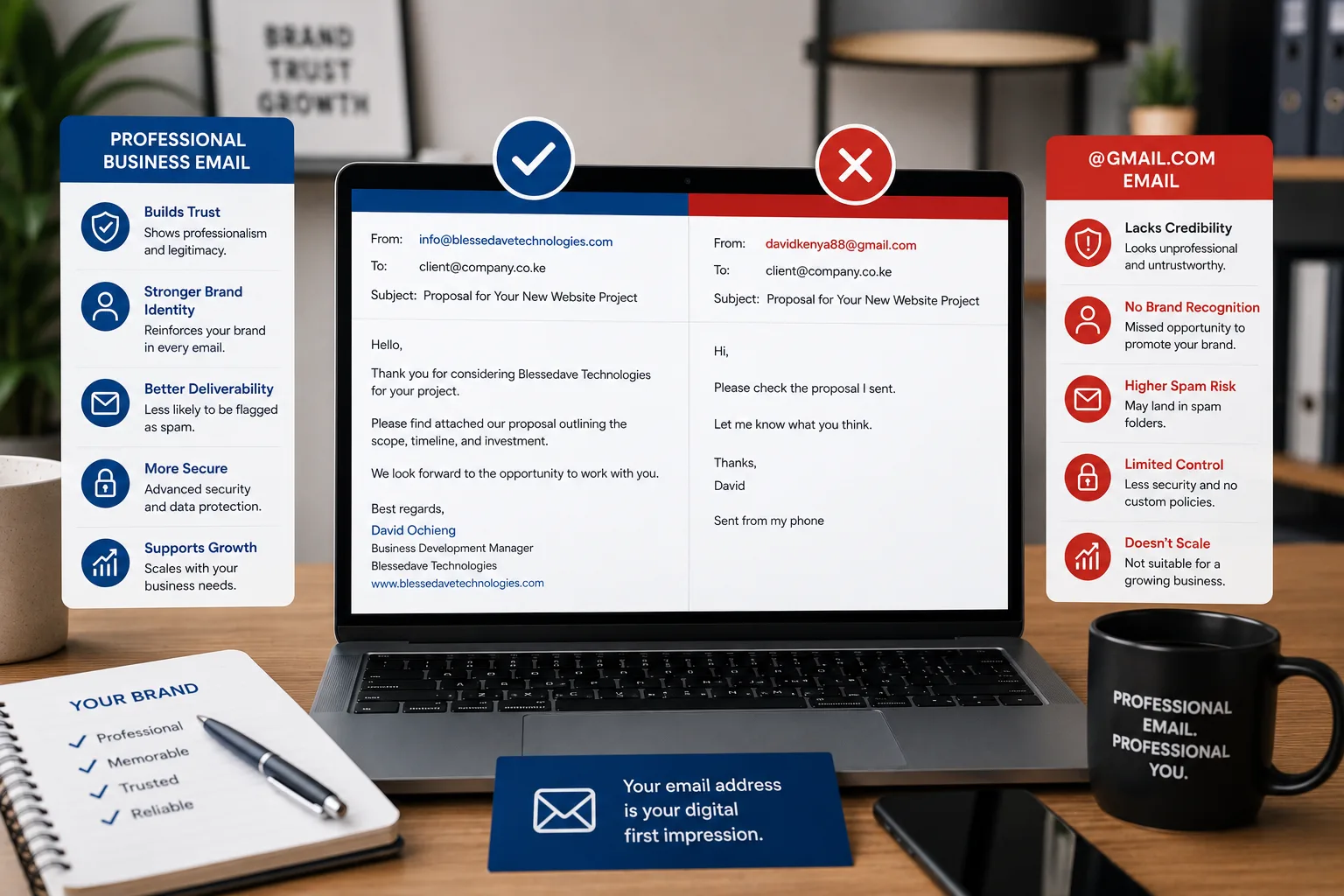
It's a small detail that quietly says a lot: an email address ending in "@gmail.com" or "@yahoo.com" instead of your own business domain. For a personal account, it's completely normal. For a business — particularly one trying to win new clients or establish credibility — it can subtly undercut trust at the exact moment a first impression is being formed.
Here's why this small detail matters more than it might seem, and how easy it actually is to fix.
Why a Generic Email Address Undermines Credibility
When a potential client or partner receives an email from "yourbusinessname@gmail.com" rather than "info@yourbusinessname.com" or "yourname@yourbusinessname.com," it subtly signals a business that either hasn't invested in proper infrastructure or isn't fully established — even if that's not actually true. In competitive industries, particularly professional services where trust is paramount, this small signal can matter more than businesses realize.
What a Professional Business Email Actually Communicates
1. Legitimacy and Establishment
A domain-matched email address reinforces that a business has its own website and infrastructure — a basic but meaningful signal of legitimacy, particularly for businesses in trust-sensitive industries like consulting, law, finance, or auditing.
2. Brand Consistency
Every email sent reinforces brand recognition when it matches the business's actual domain — a small, repeated touchpoint that consistently ties communication back to the brand, rather than a generic, disconnected address.
3. Professionalism in Client-Facing Communication
For client proposals, invoices, contracts, and ongoing correspondence, a professional email address matches the level of polish clients expect from a business they're trusting with meaningful work or money.
4. Reduced Risk of Being Filtered as Spam
Some email systems and spam filters treat generic, free-provider addresses (particularly for bulk or marketing email) with more scrutiny than properly configured business domain emails, which can affect deliverability for legitimate business communication.
Common Objections, and Why They Don't Hold Up
"It's more convenient to just use Gmail." Setting up business email through a custom domain, particularly using Google Workspace or similar providers, can actually be configured to work within the same familiar Gmail interface — meaning the convenience argument largely disappears once it's properly set up.
"It costs money." Business email hosting is generally an affordable, modest recurring cost — a worthwhile investment relative to the credibility and professionalism it reinforces, especially compared to other business expenses.
"Clients don't really notice." Many do, even if only subconsciously — particularly clients evaluating multiple options and looking for signals of legitimacy and professionalism to help differentiate between them.
What to Set Up for a Proper Professional Email Presence
1. A Domain-Matched Primary Address
At minimum, a general business address like info@yourbusiness.com or hello@yourbusiness.com for general inquiries.
2. Individual Addresses for Team Members
Named addresses (firstname@yourbusiness.com) for staff who correspond directly with clients reinforce both professionalism and accountability in communication.
3. Properly Configured Email Authentication
Setting up proper technical authentication (SPF, DKIM, DMARC records) improves deliverability and reduces the chance of legitimate business emails being filtered as spam or, conversely, of your domain being spoofed by others sending fraudulent emails appearing to come from your business.
4. A Consistent, Professional Email Signature
A well-formatted signature — name, title, contact details, and business branding — reinforces professionalism on every single email sent, and provides an easy way for recipients to find contact details or visit your website.
Choosing an Email Hosting Provider
Popular options for business email hosting include Google Workspace and Microsoft 365, both offering custom domain email within familiar, widely-used interfaces, along with additional productivity tools (document collaboration, cloud storage, calendars) that benefit growing businesses beyond email alone.
Making the Switch Without Losing Important Communication
If you're currently operating from a generic email address, transitioning to a business domain doesn't require abandoning the old address immediately — setting up forwarding from the old address to the new one during a transition period ensures you don't miss important messages while customers and contacts adjust to the new address.
A Small Change With a Meaningful Impact
Compared to many other business investments, setting up a professional business email is relatively quick and inexpensive — yet it reinforces credibility and brand consistency across every single piece of correspondence a business sends. For businesses that already have a website and domain, this is often one of the easiest, highest-value improvements still left unaddressed.
Set Up Professional Business Email With Blessedave Technologies
At Blessedave Technologies, we help Kenyan businesses set up proper, domain-matched business email — including authentication configuration and team account setup — as part of a complete, professional digital presence.
Talk to us about setting up your business email at blessedavetechnologies.com.
FAQ
Frequently asked questions
Do I need a website to get a professional business email address?
You need a registered domain name, which is often obtained alongside a website but can also be registered independently if you're not ready to build a full website yet.
Is business email hosting expensive?
Generally no — it's a modest, affordable recurring cost relative to the credibility and professionalism benefit it provides, especially through providers like Google Workspace or Microsoft 365.
Can I still use the familiar Gmail interface with a business domain email?
Yes — services like Google Workspace let you use your own domain (yourname@yourbusiness.com) within the same familiar Gmail interface, so you don't lose the convenience you're used to.
Will switching to a business email address cause me to miss messages sent to my old address?
Not if set up properly — forwarding from your old generic address to your new business address during a transition period ensures you don't miss important communication while contacts adjust.
Does a professional email address actually affect deliverability?
It can — properly configured business domain email with correct authentication (SPF, DKIM, DMARC) generally has better deliverability than generic free-provider addresses, particularly for business or marketing communication.
Is a professional email address really worth the effort for a small business?
Yes, generally — it's a relatively quick, inexpensive change that reinforces credibility and brand consistency across every piece of correspondence, making it one of the higher-value, lower-effort improvements a business can make.
Written by
Blessedave TechnologiesEditorial team
The Blessedave Technologies team designs and builds websites, custom software, e-commerce systems and SEO/AEO programmes for businesses in Nairobi and across Kenya.


Comments
No comments yet. Start the conversation.