Ask any school administrator in Kenya how they track fees, attendance, and parent communication, and there's a good chance the honest answer involves a mix of spreadsheets, paper registers, and WhatsApp groups. It works — until it doesn't. Records get lost, fee balances get miscalculated, and important messages to parents fall through the cracks.
A school management system solves this by bringing all of it into one connected platform. Here's what that actually means, and how to know if your institution is at the point where it needs one.
What Is a School Management System?
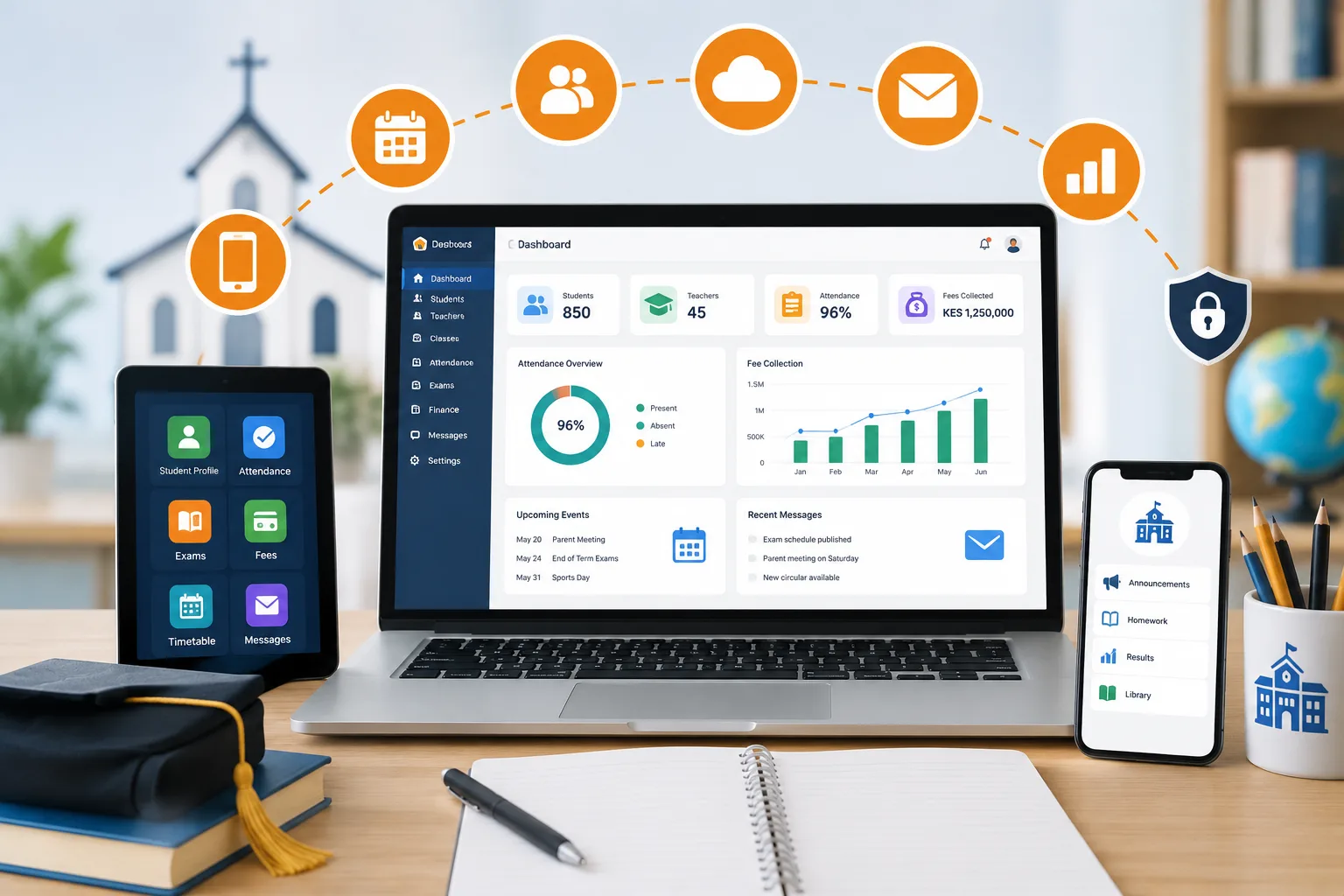
A school management system (SMS) is software designed to manage the day-to-day administrative and academic operations of a school — replacing scattered manual processes with a single, centralized platform. Depending on the institution's needs, it typically covers:
- Student records — enrollment details, academic history, personal information
- Fee management — invoicing, payment tracking, balance reminders, and receipts
- Attendance tracking — daily attendance for students and sometimes staff
- Academic records — grades, report cards, and exam results
- Communication tools — SMS, email, or app-based messaging to parents and staff
- Timetabling — class schedules, teacher assignments, and room allocation
- Staff management — payroll, leave tracking, and HR records, in more comprehensive systems
Some institutions need only a few of these modules; others benefit from a fully integrated system covering all of them.
Signs Your School Needs a Management System
1. Fee tracking is becoming error-prone or time-consuming. If your finance team spends hours reconciling fee payments manually, or parents frequently dispute balances due to tracking errors, a digital fee management module pays for itself quickly in time saved and disputes avoided.
2. Communication with parents is inconsistent. Important announcements getting lost in a crowded WhatsApp group, or reaching only some parents and not others, is a sign your school needs a more reliable communication channel — automated SMS or app notifications ensure messages reach everyone consistently.
3. Attendance and academic records are still paper-based. Paper registers are easy to lose, hard to search, and slow to compile into reports. Digital attendance and academic tracking make reporting to parents, boards, or education authorities far faster and more accurate.
4. Your school is growing. What works for 150 students on spreadsheets often breaks down at 500 or more. If your administrative team is struggling to keep up as enrollment grows, that's a strong signal a proper system is overdue.
5. Report generation takes too long. If compiling term reports, fee statements, or attendance summaries takes days of manual work each time, a system that generates these automatically frees up significant staff time for more valuable work.
Off-the-Shelf vs Custom School Management Systems
Like most software decisions, schools face a choice between an existing platform and a custom-built system. Generic, off-the-shelf school software can work well for institutions with fairly standard processes and a tighter budget. But schools with specific requirements — unique fee structures, particular reporting needs for boards or sponsors, or integration with local payment methods like M-Pesa — often get more long-term value from a custom-built system designed around exactly how they operate. We cover this decision in more depth in our guide on off-the-shelf vs custom software for Kenyan SMEs, which applies just as much to schools as to businesses.
Key Features to Look for in a School Management System
- M-Pesa integration for fee payments, allowing parents to pay directly and instantly, with automatic reconciliation
- Mobile accessibility, since many parents and even staff will check information primarily from a phone
- Role-based access, so teachers, finance staff, and administrators only see the information relevant to their role
- Automated communication, reducing the manual work of sending reminders and updates
- Data security, given the sensitive nature of student and financial records
Implementation Doesn't Have to Be Overwhelming
Many schools hesitate to adopt a management system because they imagine a disruptive, all-at-once overhaul. In practice, a phased rollout — starting with the highest-impact module, often fee management or communication — followed by gradual expansion into attendance and academic records, tends to be far smoother than switching everything at once.
Build a System Designed Around Your School
At Blessedave Technologies, we build custom school management systems tailored to how individual institutions actually operate — with M-Pesa fee integration, automated parent communication, and the specific modules your school needs, not a generic template forcing you to adapt.
Talk to us about a school management system for your institution at blessedavetechnologies.com.