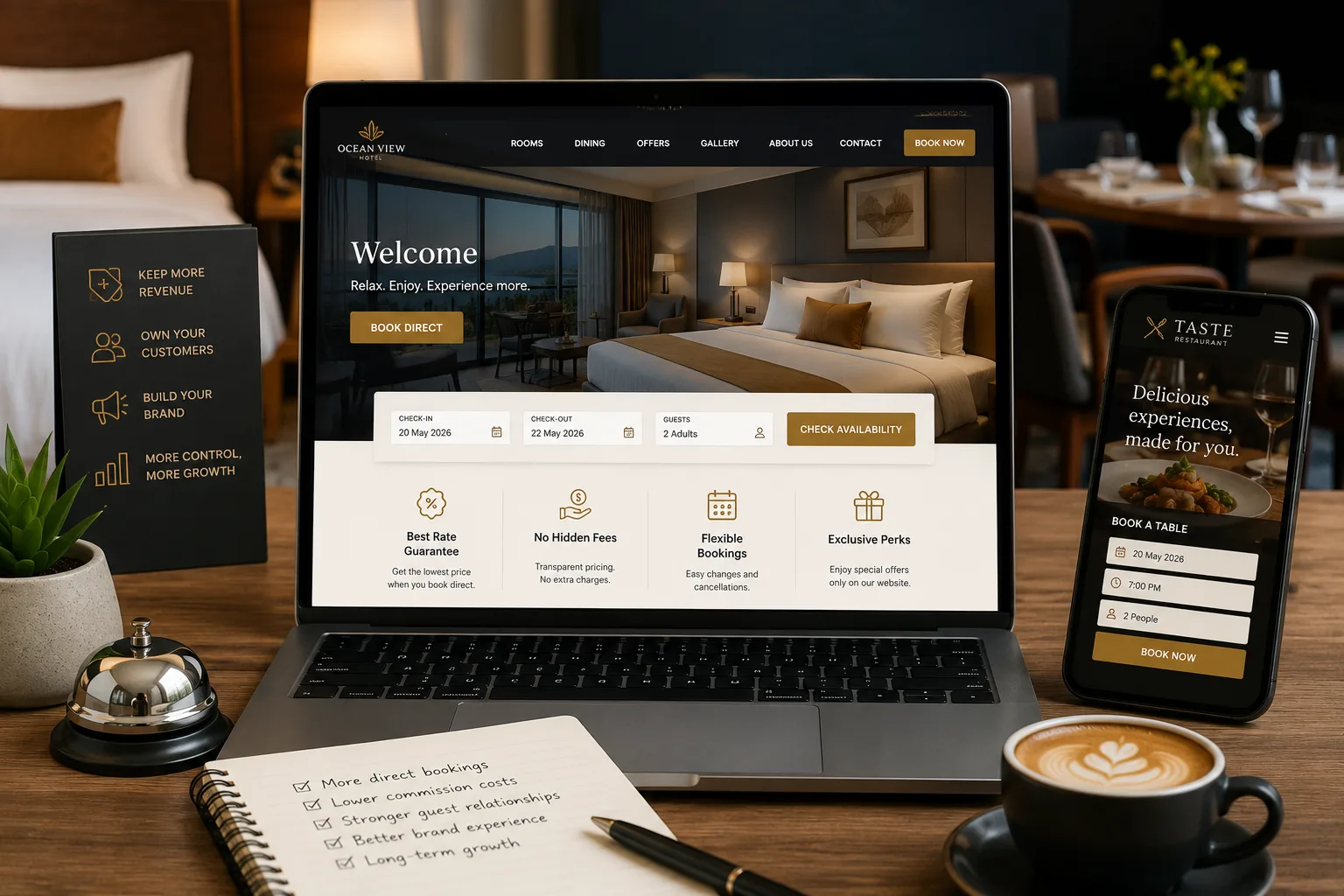
Third-party platforms — Booking.com, Airbnb, food delivery and reservation apps — have made it easier than ever for hotels and restaurants to reach new customers. But that convenience comes at a real, ongoing cost: commissions that eat into margins, no ownership of the customer relationship, and complete dependence on a platform whose rules and fees can change at any time.
A direct booking website doesn't mean abandoning third-party platforms — it means not being entirely dependent on them. Here's why that distinction matters.
The Real Cost of Relying Only on Third-Party Platforms
Commission Fees Add Up Fast
Online travel agencies (OTAs) and delivery apps typically charge commissions that can range from 15% to 30% or more per booking or order. On high-volume businesses, this adds up to a significant, recurring cost that a direct booking channel simply doesn't carry.
You Don't Own the Customer Relationship
When a guest books through a third-party platform, the platform owns the customer data — not you. You often can't easily follow up directly, build a loyalty program, or market future promotions to that guest, because the relationship technically belongs to the platform, not your business.
You're Subject to Platform Rules and Changes
Commission rates, visibility algorithms, cancellation policies — all of these can change at the platform's discretion, and your business has little say in it. A hotel or restaurant entirely dependent on third-party visibility is exposed to changes it doesn't control.
Price Parity Requirements Can Limit Your Flexibility
Many OTAs require "price parity" — meaning you can't offer a lower rate on your own website than what's listed on their platform, even though direct bookings cost you nothing in commission. Without a direct booking channel to actually capture that difference, you lose the ability to reward direct customers with better rates.
What a Direct Booking Website Actually Provides
1. Commission-Free Bookings
Every booking made directly through your own website avoids third-party commission entirely, directly improving margins on that portion of your business.
2. Full Ownership of Customer Data
Direct bookings mean you capture guest contact information, preferences, and booking history yourself — enabling email marketing, loyalty programs, and personalized offers that build repeat business over time.
3. Complete Control Over Presentation
Your own website lets you showcase your property or restaurant exactly as you want — professional photography, your actual brand voice, and detailed information that a crowded OTA listing simply doesn't allow room for.
4. Real-Time Availability and Instant Confirmation
A properly built booking system shows accurate, live availability and confirms bookings instantly, matching the convenience guests expect from third-party platforms — without the associated fees.
5. Local Payment Integration
For Kenyan guests specifically, M-Pesa integration on a direct booking site removes friction that some international OTA payment flows don't accommodate as smoothly, while card payment support via an aggregator still covers international guests.
Direct Booking Doesn't Mean Abandoning Third-Party Platforms
This isn't an either-or decision. Third-party platforms remain valuable for discovery — reaching new guests who wouldn't otherwise find you. The smartest approach most successful hospitality businesses use is:
- Use OTAs and delivery apps for visibility and new customer acquisition
- Actively encourage repeat guests and existing customers toward direct booking, often incentivized with a modest direct-booking discount or added value (free breakfast, late checkout, loyalty points)
- Build a direct booking website good enough that guests genuinely prefer using it once they know your business
Over time, this shifts a growing share of bookings toward the commission-free direct channel, without sacrificing the discovery benefits third-party platforms provide.
What a Good Direct Booking Website Needs
- A fast, mobile-friendly booking flow — since most guests will book from a phone, often while comparing multiple options
- Real-time availability synced with your other booking channels to avoid overbooking across platforms
- Clear, appealing presentation — professional photos, accurate descriptions, and transparent pricing
- M-Pesa and card payment integration for a smooth, familiar checkout experience
- Automated confirmations and reminders to reduce no-shows and manual follow-up work
- Simple incentives for direct booking, clearly communicated (e.g., "Book direct and save 10%")
A Realistic Approach to Making the Shift
- Start with a professional, mobile-friendly website with a proper direct booking system
- Sync availability with your existing OTA listings to prevent double bookings
- Introduce a modest incentive for direct bookings to encourage the shift
- Use guest data from direct bookings to build repeat business over time through email or SMS marketing
- Continue using OTAs for new customer discovery, while growing your direct channel steadily
Build a Direct Booking Website That Actually Converts
At Blessedave Technologies, we build booking websites for hotels, restaurants, and hospitality businesses — with real-time availability, M-Pesa and card payment integration, and the polished presentation needed to make direct booking genuinely appealing to your guests.
Talk to us about a direct booking website for your business at blessedavetechnologies.com.