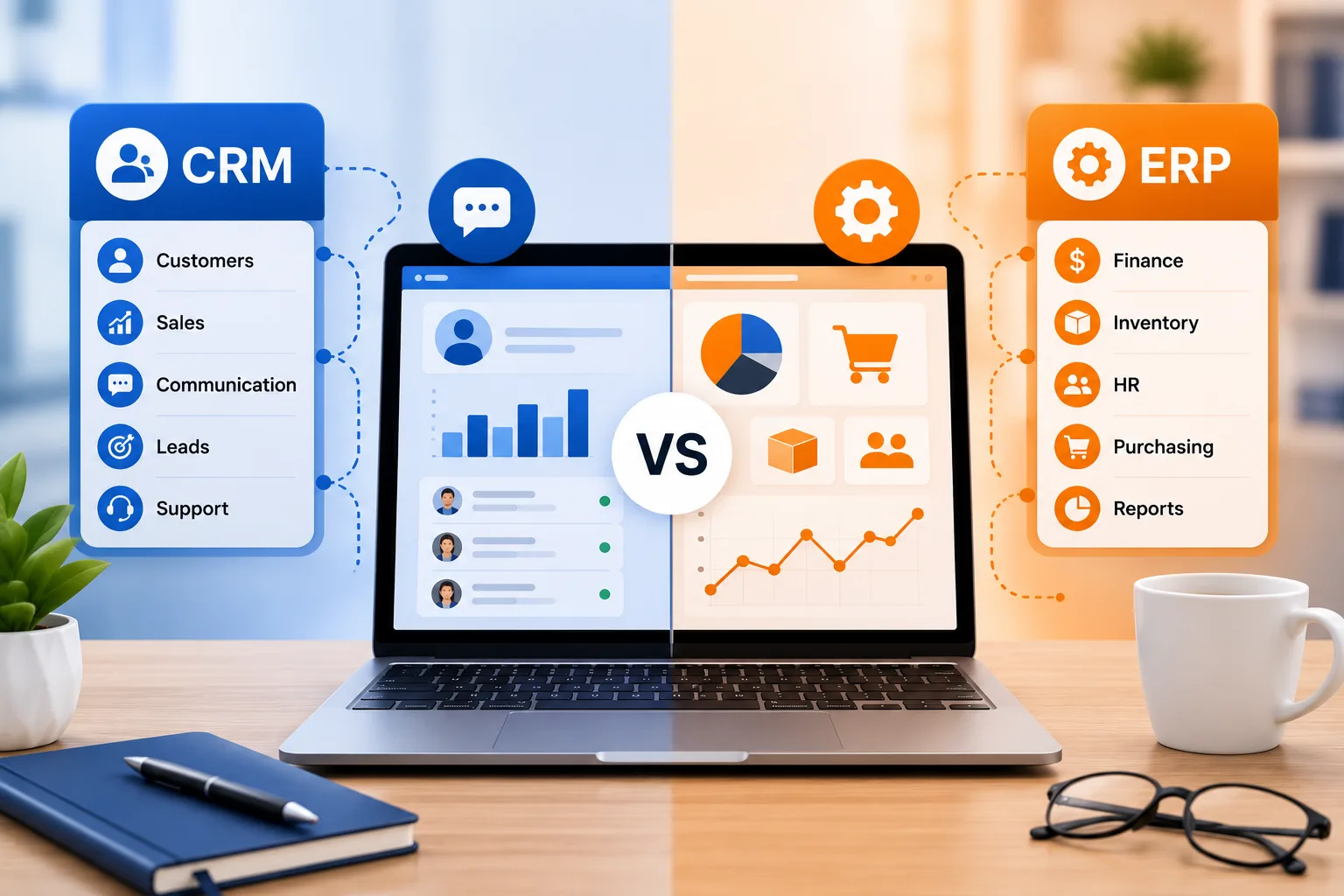
As a business grows past spreadsheets and manual tracking, two acronyms tend to come up: CRM and ERP. They're often mentioned in the same breath, sometimes even used interchangeably — but they solve genuinely different problems. Choosing the wrong one, or trying to force one system to do the other's job, is a common and costly mistake.
Here's a clear breakdown of what each actually does, and how to figure out which one — or whether both — your business needs.
What Is a CRM?
CRM (Customer Relationship Management) software is built around managing your interactions with customers and prospects — from first contact through to an ongoing relationship. A CRM typically handles:
- Contact and lead management
- Sales pipeline tracking (where each prospect is in the buying process)
- Communication history (calls, emails, meetings) with each customer
- Follow-up reminders and task management for sales and support teams
- Customer service and support ticket tracking
- Marketing campaign tracking and customer segmentation
In short: a CRM answers the question, "Where does this relationship stand, and what happens next?"
What Is an ERP?
ERP (Enterprise Resource Planning) software is built around managing a business's core internal operations — the systems that keep the business itself running, rather than managing external relationships. A typical ERP covers some combination of:
- Inventory and supply chain management
- Financial accounting and reporting
- Procurement and vendor management
- Human resources and payroll
- Production or project management
- Order fulfillment and logistics
In short: an ERP answers the question, "How is the business itself actually operating, end to end?"
The Core Difference
CRM (Customer Relationship Management)
- Primary focus: Customer-facing relationships
- Core users: Sales, marketing, and customer support teams
- Key question answered: "What's our relationship with this customer?"
- Typical modules: Leads, sales pipeline, communication history, support tickets
- Best fit for: Businesses focused on sales growth and customer retention
ERP (Enterprise Resource Planning)
- Primary focus: Internal business operations
- Core users: Finance, operations, HR, and inventory teams
- Key question answered: "How is the business running internally?"
- Typical modules: Inventory, accounting, payroll, procurement
- Best fit for: Businesses managing complex internal operations, inventory, or multi-department coordination
Signs Your Business Needs a CRM
- Your sales team is tracking leads and follow-ups manually, in spreadsheets or notebooks
- Deals are falling through the cracks because no one has visibility into where each prospect stands
- Customer communication history is scattered across individual staff members' phones and inboxes, with no shared record
- You're growing your sales team and need a consistent, trackable process rather than relying on individual memory
- Customer support requests are hard to track and follow up on consistently
Signs Your Business Needs an ERP
- Inventory tracking is manual and increasingly error-prone as your product range or stock volume grows
- Financial reporting takes significant manual effort to compile from multiple disconnected sources
- Different departments (sales, finance, operations) are working from inconsistent or duplicated data
- You're managing complex procurement, multiple suppliers, or multi-location operations that spreadsheets can no longer handle reliably
- Payroll, HR, and operational data live in separate systems that don't talk to each other
Do You Need Both?
For many growing Kenyan businesses, the honest answer is eventually yes — but rarely at the same time. A common, practical path is:
- Start with a CRM if your immediate pain point is sales and customer relationship tracking — this is usually simpler, faster to implement, and delivers value quickly
- Add ERP capabilities once internal operational complexity (inventory, multi-department coordination, financial reporting) becomes the bigger bottleneck
- Consider an integrated system if both pain points are significant simultaneously — some custom-built systems combine CRM and ERP functionality into a single platform, avoiding the complexity of maintaining two separate systems
Off-the-Shelf vs Custom: Which Approach Fits?
Generic, off-the-shelf CRM and ERP platforms can work well for businesses with fairly standard processes, and they're often faster and cheaper to get started with. But businesses with specific workflows — particular reporting requirements, unique inventory categorization, local payment integration like M-Pesa — often find these platforms require significant workarounds, or simply don't fit well without expensive customization add-ons.
A custom-built CRM or ERP, by contrast, is designed around your business's actual processes from the start — no forcing your team to adapt to someone else's template. We cover this broader decision in more depth in our guide on off-the-shelf vs custom software for Kenyan SMEs.
What to Consider Before Committing to Either
- Team size and complexity. A very small team may not need a full CRM or ERP yet — sometimes a well-organized spreadsheet genuinely is sufficient until the business reaches a certain scale.
- Budget and timeline. Custom systems take longer and cost more upfront than off-the-shelf options, but often deliver better long-term fit and avoid recurring license fees.
- Integration needs. Consider whether the system needs to connect with existing tools — accounting software, M-Pesa, your website — since this significantly affects both cost and complexity.
- Growth trajectory. Building with your expected growth in mind avoids a costly system migration a year or two down the line.
Build the Right System for How Your Business Actually Works
At Blessedave Technologies, we help Kenyan businesses identify whether a CRM, an ERP, or an integrated custom system fits their actual operations — then build it around your specific workflows, not a generic template.
Talk to us about the right system for your business at blessedavetechnologies.com.