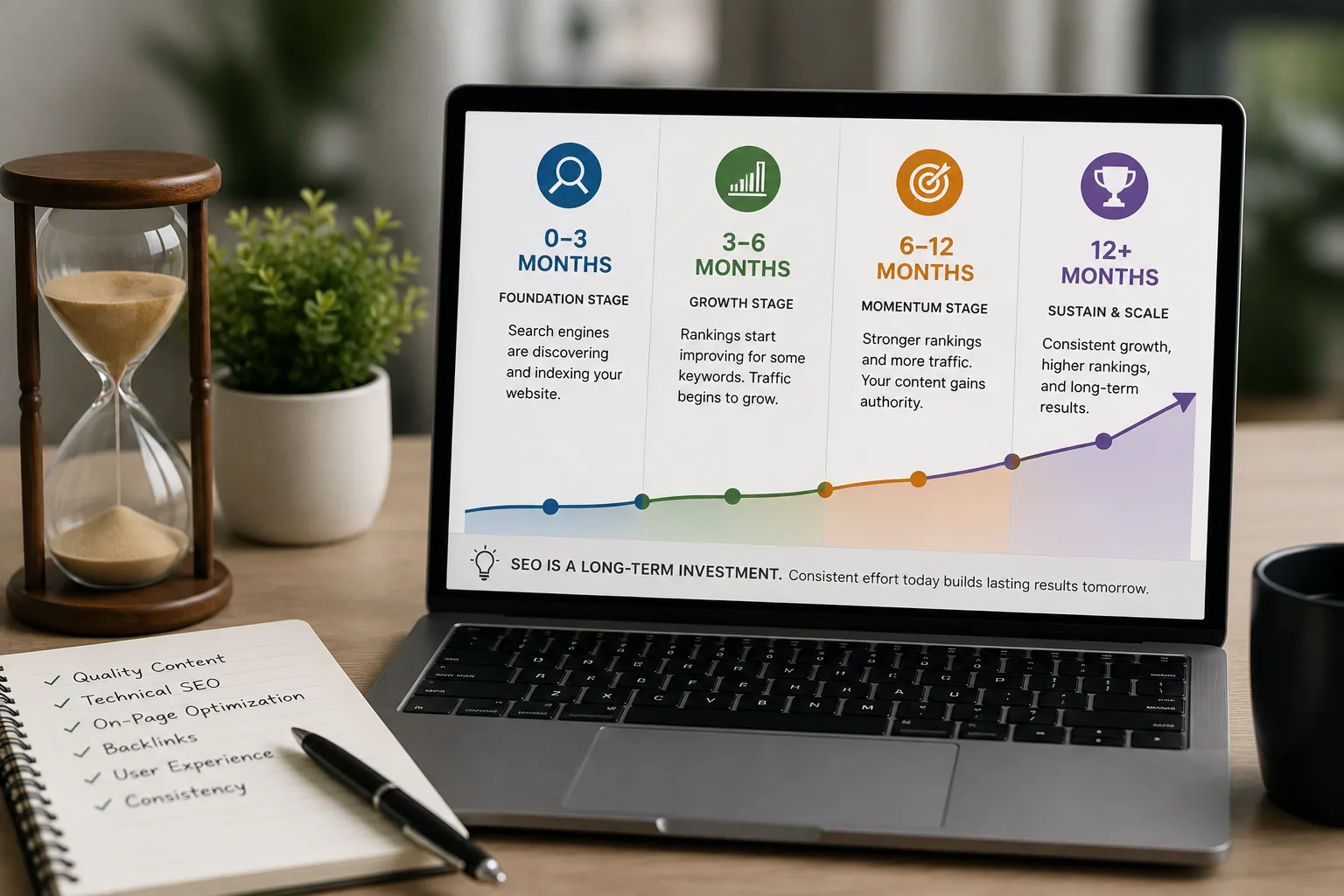
"How long until we rank on Google?" is one of the most common questions businesses ask when starting SEO — and one of the most frequently misunderstood. Unlike paid ads, which can drive traffic the moment a campaign launches, SEO is fundamentally a compounding, long-term effort. Businesses expecting overnight results are often disappointed, not because SEO doesn't work, but because the timeline was never realistic to begin with.
Here's an honest breakdown of what to actually expect, and why.
Why SEO Takes Time by Design
Search engines don't just index new content instantly and rank it based on quality alone — they weigh factors that accumulate over time: how consistently a site publishes relevant content, how many other credible sites link to it, how users engage with it, and how technically sound it is. None of these signals can be manufactured overnight; they build progressively, which is precisely why SEO takes months rather than days to show meaningful results.
A Realistic Timeline, Stage by Stage
Months 1–2: Foundation and Technical Setup
This early period covers technical SEO fixes (site speed, mobile-friendliness, proper site structure), keyword research, and initial content creation or optimization. Meaningful ranking movement is uncommon during this phase — the work here lays the groundwork everything else builds on.
Months 2–4: Early Signals and Initial Movement
Search engines begin properly indexing and evaluating new or optimized content. Some lower-competition, specific keywords may start showing modest ranking improvements, though significant traffic increases are still generally limited during this period.
Months 4–6: Noticeable Traction
For many businesses, this is when organic traffic and rankings for targeted keywords start becoming genuinely noticeable — particularly for less competitive search terms. Content published earlier in the process often begins gaining real traction around this point.
Months 6–12: Compounding Results
This is typically when SEO efforts start compounding meaningfully — content published months earlier continues climbing, domain authority builds from accumulated backlinks and consistent publishing, and traffic growth becomes more substantial and sustained.
12+ Months: Established Authority
Beyond a year of consistent effort, well-executed SEO typically produces durable, compounding organic traffic that continues generating leads with less incremental effort than the initial buildup required — the payoff period for the sustained investment made earlier.
What Affects How Fast You'll See Results
- Competition in your industry and location. A niche local service faces less competition than a broad, high-demand national category, and will typically see results faster.
- Your site's starting point. A brand-new website starts from zero, while an established site with some existing authority can see faster initial movement.
- Consistency of effort. Sporadic, occasional SEO work produces meaningfully slower results than consistent, ongoing publishing and optimization.
- Content quality and specificity. Genuinely useful, specific content tends to perform better and faster than generic, thin content produced purely to "have something published."
- Technical foundation. A site with underlying technical issues (slow speed, poor mobile experience) will see slower results even with strong content, since these issues undermine everything built on top of them.
Why "Quick Fix" SEO Promises Are a Red Flag
Any provider promising first-page rankings within days or weeks is either describing paid advertising (a different tool entirely) or using tactics that violate search engine guidelines — approaches that can produce a short-term bump followed by a penalty that sets a site back much further than if nothing had been done at all. Genuine, sustainable SEO simply doesn't move that fast, and it's worth being skeptical of anyone claiming otherwise.
Setting Realistic Internal Expectations
For businesses starting SEO, it helps to frame it internally as a compounding, long-term investment rather than a short-term campaign with an immediate return, similar to how one might think about building a reputation or referral network — steady, consistent effort that pays off increasingly over time rather than delivering a single dramatic spike.
How to Make the Most of the Waiting Period
- Combine SEO with other channels (social media, paid ads, direct outreach) for near-term visibility while SEO builds in the background
- Track leading indicators, not just rankings — impressions, click-through rates, and keyword position improvements often show progress before major traffic increases become visible
- Stay consistent — publishing and optimizing steadily over months matters more than any single burst of activity
- Be patient with content that hasn't peaked yet — some of the strongest-performing pages take 6+ months to reach their full potential, even when they were well-written from the start
Get an Honest SEO Timeline for Your Business
At Blessedave Technologies, we set realistic, honest SEO timelines from the start — based on your specific industry, competition, and starting point — and combine SEO with AEO best practices to build durable, compounding organic visibility over time.
Talk to us about a realistic SEO plan for your business at blessedavetechnologies.com.