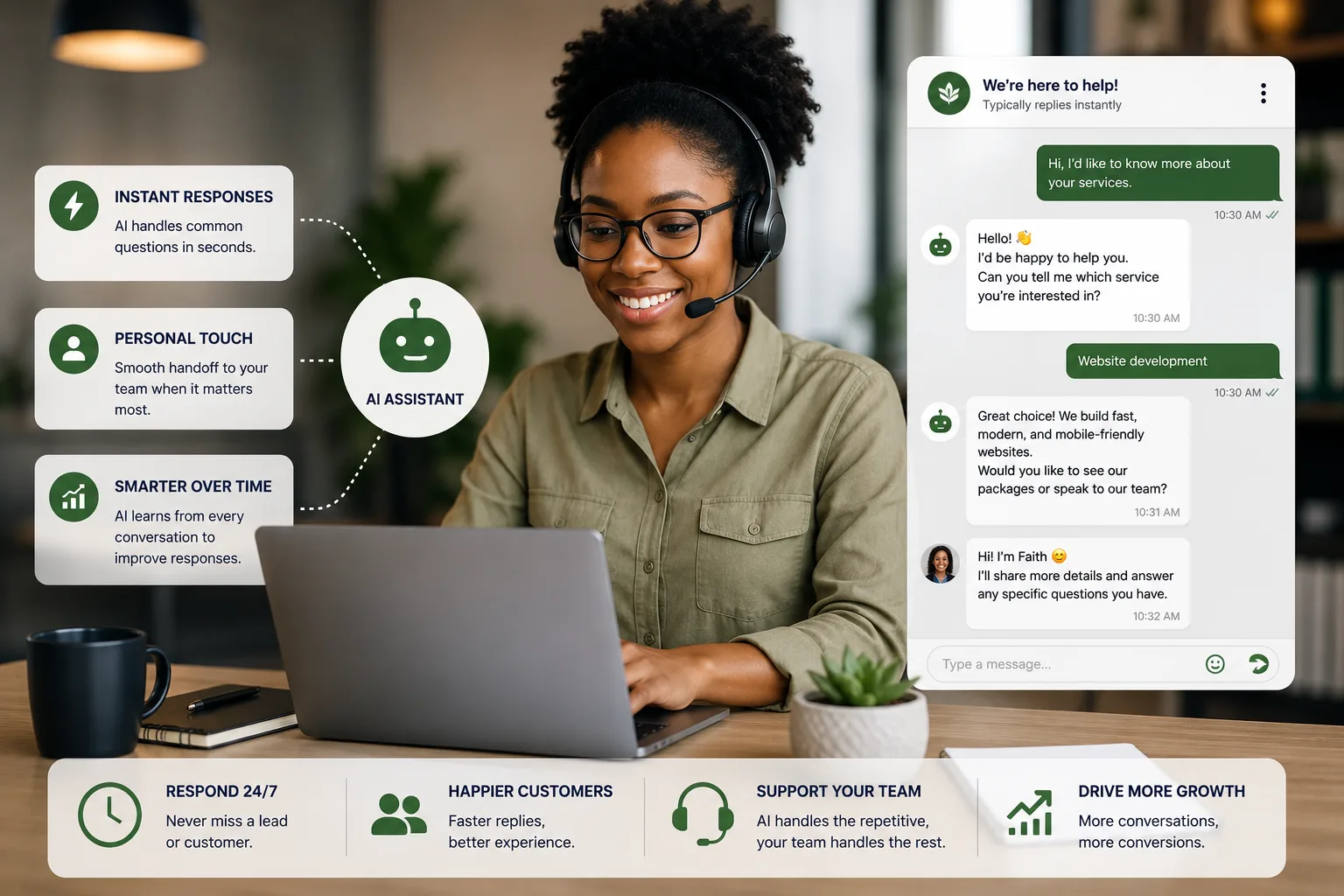
Customers today expect fast replies — often within minutes, not hours. AI tools make that speed genuinely achievable, even for a small team. But there's a real risk that comes with moving fast: responses that feel robotic, generic, or impersonal can damage the very trust you're trying to build through quick service.
The good news is that speed and personal touch aren't actually opposites — they just require a deliberate approach. Here's how to use AI to respond faster without customers feeling like they're talking to a machine.
Why Response Speed Matters So Much
Customers increasingly judge a business's reliability by how quickly it responds, not just by the quality of the eventual answer. A slow response — even to a simple question — can lose a sale to a faster-replying competitor, particularly for time-sensitive inquiries like availability, pricing, or booking requests. AI-powered tools close this gap by providing near-instant first responses, any time of day.
Where AI Speed Genuinely Helps
- Immediate acknowledgment — confirming a message was received, even before a full answer is ready
- Answering routine, repetitive questions — hours, pricing, availability — instantly and consistently
- After-hours coverage — ensuring a customer messaging at 11pm gets an immediate response rather than radio silence until morning
- Triaging inquiries — quickly routing a question to the right person or department before a human even sees it
Where Speed Without Care Backfires
- Generic, obviously templated responses to specific or emotionally charged questions feel dismissive rather than helpful
- AI misreading nuance or tone, giving a technically accurate but tone-deaf response to a frustrated or upset customer
- No clear path to a human when the AI reaches the edge of what it can handle, leaving the customer stuck
- Over-automation of relationship-dependent interactions — a customer negotiating a significant purchase or resolving a serious complaint generally wants to feel heard by a person, not processed by a system
How to Balance Speed and Personal Touch
1. Use AI for the First Response, Not Necessarily the Only Response
A fast, AI-generated acknowledgment — "Thanks for reaching out, someone will get back to you shortly with details" — buys time without leaving a customer waiting in silence, even if a human ultimately handles the substantive reply.
2. Personalize What AI Sends, Where Possible
Even automated responses can reference specific details — the customer's name, the specific product or service they asked about — rather than a fully generic template. Small touches like this make automated replies feel considerably less robotic.
3. Reserve Complex or Sensitive Conversations for Humans
Define clear boundaries for what AI handles versus what gets routed to a person — routine questions and confirmations to AI, genuine complaints, negotiations, or emotionally charged conversations to a human, ideally as quickly as possible once identified.
4. Write AI Responses in Your Actual Brand Voice
Generic, corporate-sounding AI responses feel noticeably different from the way your business actually communicates elsewhere. Taking the time to configure AI tools with your specific tone — casual or formal, warm or efficient — makes automated replies feel more consistent with the rest of your customer experience.
5. Let Customers Know When They're Talking to AI (and How to Reach a Human)
Transparency builds trust rather than eroding it. Clearly indicating an automated first response, with an easy, visible option to reach a person, respects the customer's time and avoids the frustration of feeling stuck talking to a bot with no way out.
6. Use AI to Free Up Time for the Interactions That Matter Most
The real value of AI handling routine inquiries isn't just speed — it's that it frees your team's time and attention for the conversations that genuinely benefit from a human touch: complex problem-solving, relationship-building, and situations where empathy matters more than speed.
7. Regularly Review Real Conversations
Periodically reviewing actual AI-handled conversations reveals where responses are landing well and where they're falling flat — feeding directly back into refining tone, content, and the boundary between what AI handles and what gets escalated to a person.
A Practical Example
Fully automated, impersonal: "Thank you for contacting us. Your inquiry has been received. We will respond within 24 hours."
AI-assisted, personal: "Hi Sarah, thanks for asking about the 2-bedroom listing in Kilimani! I've flagged this for our agent to confirm current availability — expect a reply within the hour. In the meantime, here's the listing link with more photos: [link]"
The second example moves just as fast, but feels like a business that's actually paying attention — not a system processing a ticket number.
Getting the Balance Right Over Time
There's no single perfect formula — the right balance depends on your industry, your customers' expectations, and the nature of a given inquiry. The most successful businesses treat this as an ongoing calibration: starting with AI handling clearly routine tasks, monitoring how customers respond, and adjusting the boundary between automation and human involvement as they learn what actually works for their specific audience. This is one piece of the broader picture we cover in our guide on 5 ways AI automation can save your business hours every week.
Build AI-Assisted Customer Service That Still Feels Personal
At Blessedave Technologies, we help Kenyan businesses implement AI-powered customer response tools — configured in your actual brand voice, with clear handoffs to your team — so you get faster response times without sacrificing the personal touch your customers value.
Talk to us about AI-assisted customer service for your business at blessedavetechnologies.com.