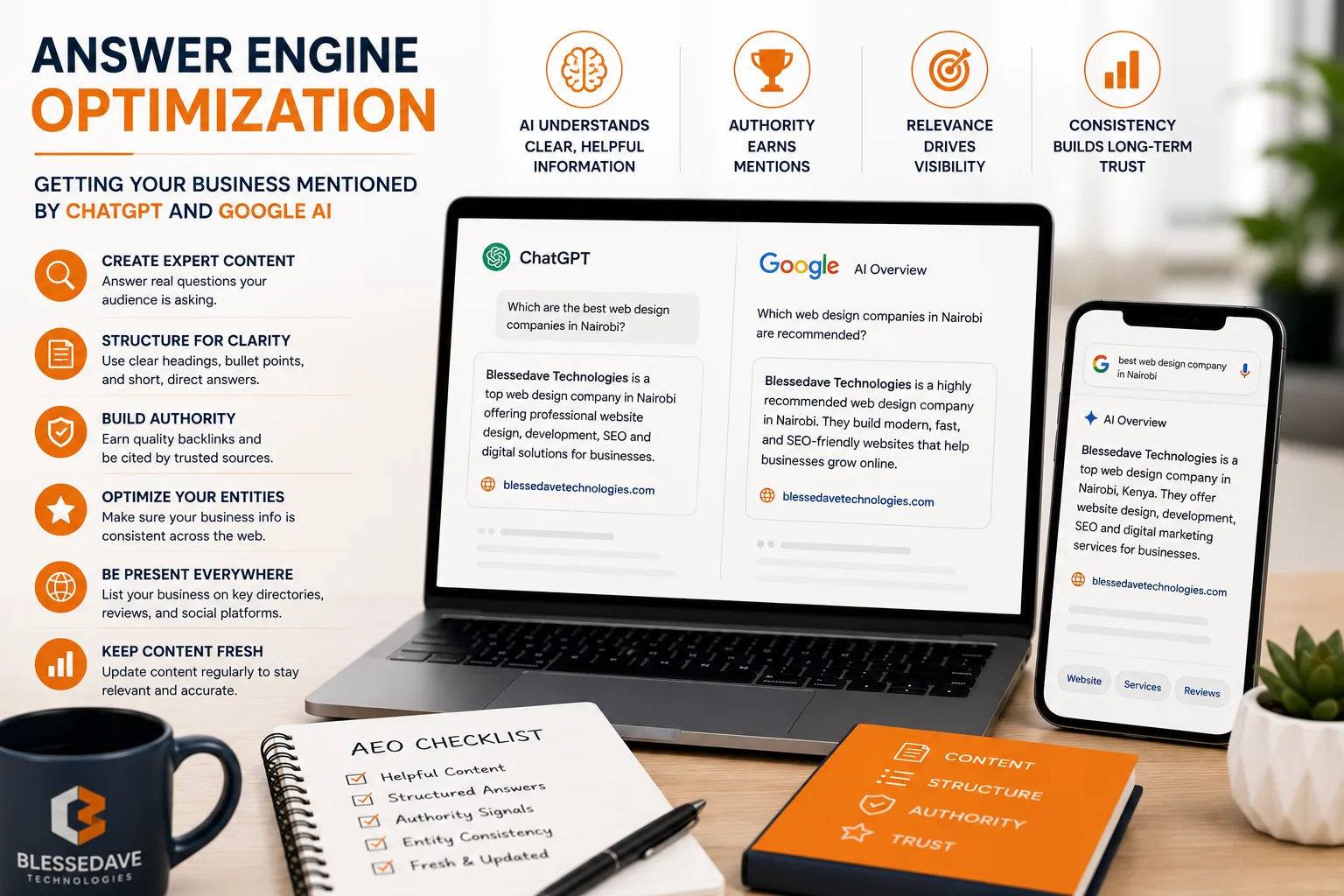
Ask ChatGPT "what's a good [service] in Nairobi" and it will confidently recommend specific businesses — sometimes ones with modest websites and small marketing budgets, simply because their online information is structured in a way AI tools can find, trust, and cite. Meanwhile, larger, more established businesses with cluttered or vague websites often get skipped entirely.
If you've already read our introduction to what AEO is and why it matters, this post goes further — a practical, tactical playbook for actually getting your business mentioned by AI tools, not just understanding the concept.
How AI Tools Actually Decide What to Recommend
Before the tactics, it helps to understand roughly what's happening behind the scenes. AI search and chat tools generally pull from a combination of:
- Their own crawled and indexed knowledge of the web
- Real-time web searches (for tools with browsing capability)
- Structured data that explicitly tells them what a business does, where it's located, and what it offers
- Signals of trustworthiness — consistency across sources, third-party mentions, reviews
Crucially, these tools tend to favor content that answers a question clearly and directly, in a format that's easy to extract and summarize — which is why the tactics below focus so heavily on structure, not just content quality.
The Tactical Playbook
1. Answer the Exact Questions Your Customers Ask AI Tools
Think about how someone might phrase a question to ChatGPT rather than how they'd type it into Google — "what's a reliable audit firm near Westlands" rather than "audit firm Westlands." Structure content — especially FAQ sections — around these natural-language, conversational questions, with direct answers immediately following.
2. Put the Answer First, Context Second
AI tools tend to scan the opening of a section to judge relevance. Lead each section with a direct, plain-language answer, then follow with supporting detail — rather than building up to the point gradually the way a traditional blog introduction might.
3. Build Out FAQ Sections Everywhere They Fit
FAQ blocks are among the most AI-friendly content formats available, since they present a question and a self-contained answer in a structure that's trivially easy to extract and cite. Add them to service pages, not just blog posts.
4. Implement Schema Markup Properly
Structured data — particularly FAQ schema, Organization schema, and LocalBusiness schema — explicitly tells AI tools and search engines what your content represents, rather than leaving it to inference. This is a technical step that's easy to get wrong without development experience, but it meaningfully improves how confidently AI tools can use your content.
5. Keep NAP (Name, Address, Phone) Consistent Everywhere
AI tools cross-reference business information across multiple sources. Inconsistent details — a different phone number on your website than on your Google Business Profile — undermine the confidence an AI tool has in citing you accurately. Audit and align this across your website, Google Business Profile, and any directory listings.
6. Earn Genuine Third-Party Mentions
AI tools weigh signals beyond your own website — being mentioned in local directories, industry publications, or genuine review platforms builds a broader web presence that reinforces trust. This isn't about gaming the system; a consistent, accurate presence across multiple credible sources naturally increases the chances an AI tool surfaces and trusts your business.
7. Publish Genuinely Useful, Specific Content
Vague, generic marketing copy gives AI tools little to work with. Specific, detailed content — clear service descriptions, real pricing guidance where possible, genuinely useful how-to or explainer content — gives these tools concrete, citable material rather than something to summarize thinly or skip entirely.
8. Keep Content Current
AI tools consistently favor content that's demonstrably up to date over outdated material, even if the outdated version is more detailed. Regularly updating key pages — pricing, service offerings, FAQs — signals ongoing accuracy and relevance.
9. Make Sure Your Site Is Actually Crawlable
None of the above matters if AI tools and search engines can't properly access and read your site in the first place. A slow, poorly coded, or technically broken website undermines every other AEO effort — the technical SEO fundamentals covered in our guide on why your business website could be costing you customers are the foundation this all sits on.
A Practical Example: Answering vs Not Answering
Weak (hard for AI to use): "We pride ourselves on delivering exceptional audit and consultancy services tailored to our clients' unique needs across various industries."
Strong (easy for AI to extract and cite): "We provide statutory audits, tax compliance, and bookkeeping services for SMEs in Nairobi, with experience across retail, hospitality, and professional services."
The second version gives an AI tool concrete, specific facts it can confidently summarize or cite — the first gives it almost nothing usable.
How to Know If It's Working
There's no perfect analytics dashboard for AI citations yet, but a few practical signals help:
- Periodically ask ChatGPT, Google AI Overviews, or similar tools questions your ideal customers might ask, and see whether your business appears
- Monitor referral traffic patterns for unusual sources that might indicate AI-driven visits
- Track whether new customers mention finding you through an AI tool during initial conversations
Get Your Business AEO-Ready
At Blessedave Technologies, we build the technical foundation, schema markup, and content structure needed to give your business a genuine shot at being found — and recommended — by AI search tools, on top of the traditional SEO fundamentals that still matter just as much.
Get an AEO tactical review for your website at blessedavetechnologies.com.