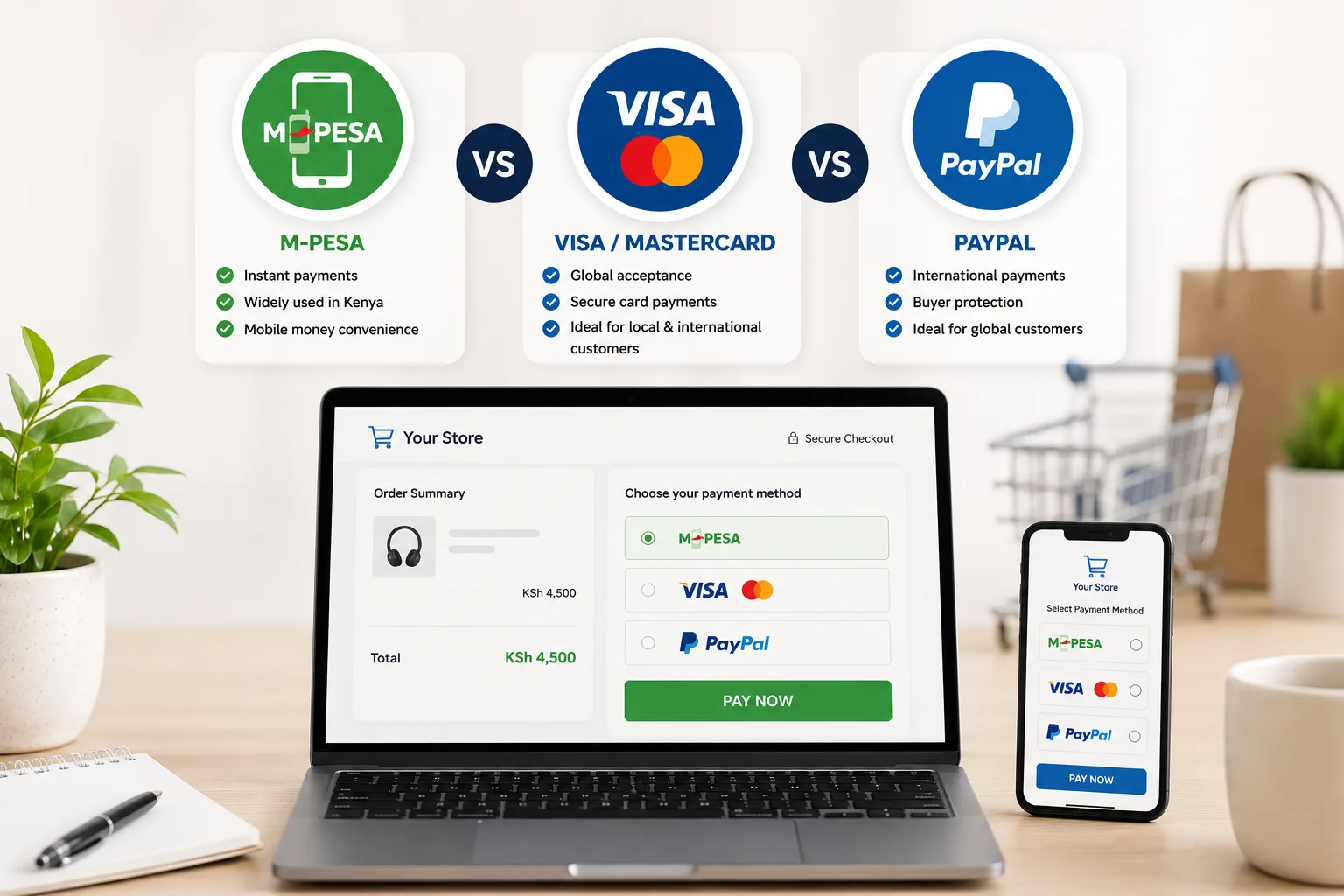
Choosing a payment gateway is one of the most consequential decisions a Kenyan online store makes — get it wrong, and customers abandon their carts at the exact moment they're ready to buy. Get it right, and checkout becomes a non-issue instead of a barrier.
The core question usually comes down to three payment types: M-Pesa, card payments (Visa/Mastercard), and PayPal. Here's how they compare, and how most Kenyan online stores end up combining them.
M-Pesa: The Non-Negotiable Foundation
For any store selling primarily to Kenyan customers, M-Pesa isn't optional — it's the baseline. Mobile money dominates everyday transactions in Kenya, and most Kenyan shoppers expect to pay via M-Pesa STK Push (the prompt that appears on their phone asking for their PIN) rather than entering card details.
How to integrate it:
- Direct integration via Safaricom's Daraja API — the lowest-cost route, with fees typically around 1.0–1.5% per transaction, but requires development work to implement and maintain, and only supports M-Pesa (no cards).
- Through a payment aggregator (Pesapal, Flutterwave, DPO, IntaSend, Paystack) — adds a small additional fee on top of the underlying M-Pesa cost, but bundles in cards, dashboards, and easier setup, often with plugins for WooCommerce, Shopify, and other platforms.
Settlement: Direct Daraja integration settles instantly to your Paybill or Till. Aggregators typically settle M-Pesa transactions to your bank account within 1–3 business days.
Visa/Mastercard: Reaching Card-Paying and International Customers
While M-Pesa covers the majority of everyday Kenyan transactions, card payments still matter — for higher-value purchases, business customers, and international shoppers (tourists, diaspora buyers, or cross-border clients) who don't have a Kenyan mobile money account.
How to accept cards in Kenya: Card payments in Kenya are almost always processed through an aggregator rather than directly, since building your own card processing infrastructure requires costly compliance (PCI-DSS) that's impractical for most SMEs. Providers like Flutterwave, Paystack, Pesapal, and DPO Pay all support Visa and Mastercard alongside M-Pesa in a single checkout.
Fees: Card transaction fees in Kenya generally run higher than M-Pesa fees — typically in the range of 2.9–3.9% depending on the provider and whether the card is local or international.
Settlement: Slower than M-Pesa — often 1–5 business days depending on the provider and whether the transaction is local or international.
PayPal: Useful for Receiving Money, Limited as a Store Checkout
PayPal works differently in Kenya than in the US or Europe, and it's worth separating two questions: can Kenyans receive PayPal money at all (yes), and can a Kenyan online store use PayPal as its checkout gateway (not really, in practice).
Receiving and withdrawing PayPal funds: Kenyans can receive PayPal payments into a personal PayPal account and withdraw the balance locally in two main ways:
- Via M-Pesa — a partnership between Safaricom and PayPal (originally routed through Equity Bank, later Thunes) lets users withdraw PayPal balances directly into M-Pesa, now built into the M-Pesa Super App under the "Global" section. A conversion fee typically applies (commonly cited in the range of roughly 1.5–3%), on top of PayPal's own FX margin, with funds usually landing within minutes to a few business days depending on the route and amount.
- Via Equity Bank — Equity operates its own official PayPal withdrawal service, moving funds directly into an Equity account, generally within about 1 business day. This route is often favored for larger sums since Equity's exchange rate can be more competitive than the M-Pesa route at scale, while other banks generally support PayPal only indirectly through card-linking.
Why it's still limited for online stores: Kenyan PayPal accounts are personal-grade only — PayPal does not currently offer PayPal Business accounts to Kenyan-registered businesses, and there's no PayPal checkout button or API for accepting customer payments directly on a Kenyan e-commerce site the way Pesapal, Flutterwave, or DPO offer. Using a personal PayPal account to receive frequent, storefront-style commercial payments also carries a real risk of account restrictions, since PayPal's systems are built to flag personal accounts receiving repeated commercial transactions.
Practical implication: PayPal is genuinely useful for Kenyan freelancers and businesses receiving occasional international payments from clients abroad — with M-Pesa or Equity Bank as the withdrawal route. But it isn't a viable checkout gateway to embed in your online store. For accepting customer payments directly on your site, an aggregator that supports Visa/Mastercard (Pesapal, Flutterwave, DPO, Paystack) remains the practical choice, even for international card-paying customers.
What Most Kenyan Online Stores Actually Use
In practice, most successful Kenyan e-commerce stores don't choose just one option — they combine them:
- M-Pesa STK Push as the primary, default checkout method, since it's what the majority of Kenyan customers expect and prefer
- Card payments via an aggregator (Pesapal, Flutterwave, or similar) as a secondary option, to capture card-paying and international customers
- PayPal only if there's a specific, confirmed need, rather than by default
This combination — rather than any single option alone — tends to minimize cart abandonment while keeping fees and complexity manageable. We cover the broader set of features that support this kind of conversion-focused checkout in our guide on 7 features every Kenyan online store needs to convert visitors into buyers.
How to Choose the Right Setup for Your Store
- Small store, tight budget, mostly local customers: Start with an aggregator like Pesapal or a similar provider that bundles M-Pesa and cards into one simple integration.
- High transaction volume, in-house developers: Direct Daraja integration for M-Pesa can reduce fees meaningfully at scale, paired with a card aggregator for card payments.
- Selling across multiple African countries: A pan-African aggregator like Flutterwave offers one integration covering multiple markets, not just Kenya.
- Hospitality, tourism, or high-value international transactions: DPO Pay's multi-currency strength and enterprise features are often a better fit than a purely local-first gateway.
Get Your Checkout Set Up Right
Choosing the wrong payment setup is a costly, avoidable mistake — excessive fees, failed payments, or a checkout that quietly turns customers away before they complete a purchase. At Blessedave Technologies, we help Kenyan businesses integrate the right combination of M-Pesa, card, and payment gateway options directly into their online store, matched to their specific customer base and budget.
Get help choosing and integrating the right payment gateway at blessedavetechnologies.com.